Turn on captions for subtitles! Take a look at our article on science.lu https://bit.ly/3RbXXIC https://bit.ly/47CFZ9k …
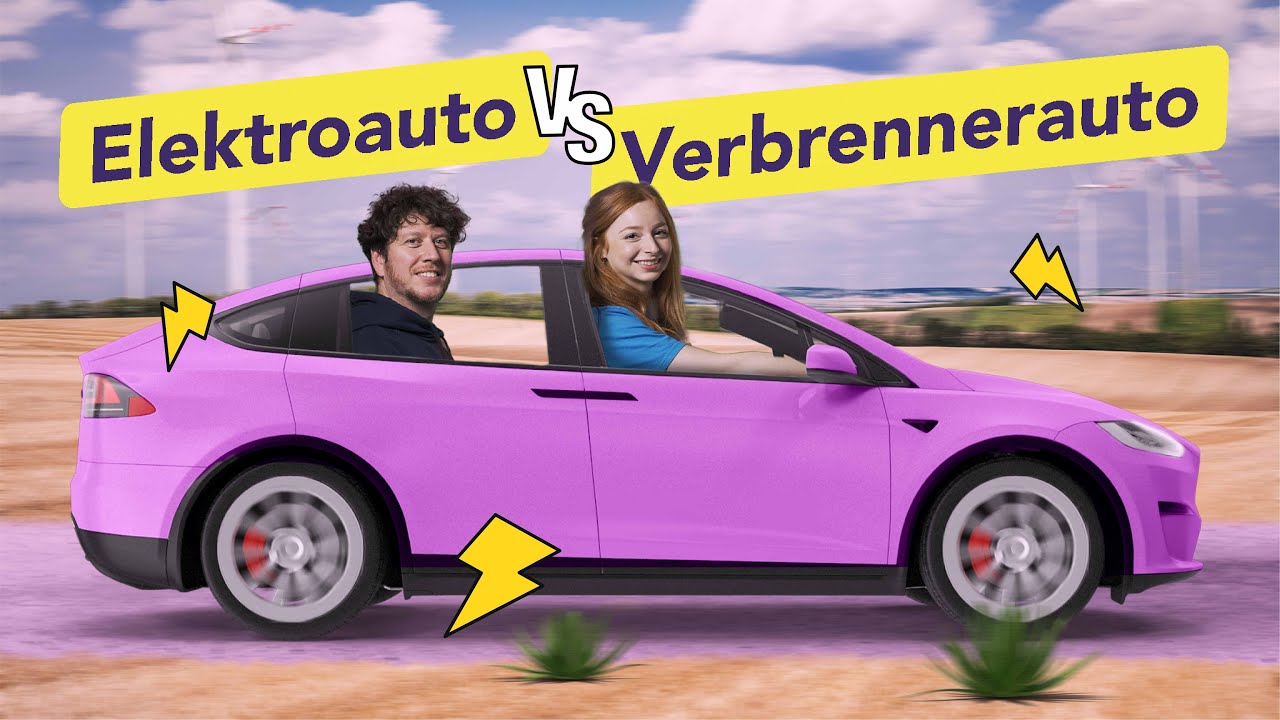
CO2 Footprint: Electric Car vs Combustion Engine Car 🚗🔌 (LU) | “Ziel mir keng!” – Ep. 14
0.4 In the context of the climate crisis,
0.4 electric cars are supposed to help
0.4 reduce the CO2 footprint.
0.4 But do electric cars really emit
less CO2 than combustion engines?
0.4 Indeed, the advantages and disadvantages of electric cars
0.4 and combustion cars have been debated extensively.
0.4 Combustion engines produce a lot of
0.4 environmentally harmful exhaust fumes.
0.4 Electric vehicles could contribute to
0.4 better air quality in city centres.
0.4 Every car manufacturer is already testing them today.
0.4 But what about the carbon footprint now?
0.4 According to the European Commission,
0.4 no new combustion cars may be sold in Europe from 2035.
0.4 This is one of the measures to become climate-neutral by 2050.
0.4 While electric cars don't require diesel or petrol,
0.4 they do need electricity and a battery instead.
0.4 Does this really save CO2?
0.4 For those who want the answer right away:
0.4 Electric cars have a lower CO2 footprint
0.4 if you drive them long enough.
0.4 Can you go into more detail now?
0.4 Yes, yes, let's do it!
0.4 Specifically, we will examine at which kilometre threshold an electric car
0.4 is worthwhile compared to a combustion engine
0.4 by comparing production, usage,
0.4 and the entire life cycle.
0.4 By the way, and this is important:
0.4 We must of course always compare models
0.4 that are truly comparable, i.e., similar in size, power, and year of manufacture.
0.4 And one more thing:
0.4 We aren't here to promote
0.4 either type of car.
0.4 Our focus is solely on comparing their CO2 footprints.
0.4 There are of course other considerations
0.4 for and against each car type –
0.4 such as practicality, cost,
0.4 and the availability of raw materials, etc. –
0.4 which we won't delve into here due to time constraints.
0.4 Let's start by examining the
0.4 CO2 footprint during production:
0.4 The carbon footprint of an electric car
0.4 is around 1.5 times higher than that of a combustion engine –
0.4 as mentioned, for comparable models.
0.4 The most significant difference lies in
0.4 the energy-intensive production of the electric car battery.
0.4 So:
0.4 1:0 for the combustion engine!
0.4 But what about during use?
0.4 The combustion engine car emits around
0.4 3-4 times more CO2 than the electric car.
0.4 How did we come up with that?
0.4 The CO2 footprint in this scenario
depends mainly on two factors:
0.4 Firstly, the energy efficiency of the engine,
0.4 and secondly, the energy source.
0.4 Let's start with the energy efficiency of the engine:
0.4 in other words, what percentage of
the energy we input into the car
0.4 is actually used for driving
0.4 and getting around?
0.4 With electric cars, we achieve
0.4 an overall energy efficiency of 80-90%.
0.4 That's quite a lot!
0.4 Yes, that's right.
0.4 So, 80-90% of the energy contained in the electricity
0.4 used to charge the electric car
0.4 is effectively used for travelling.
0.4 The rest is lost –
0.4 primarily during battery charging
0.4 and the conversion of electrical
energy into propulsion.
0.4 In contrast, the combustion engine only achieves an
0.4 overall energy efficiency of around 30-40%.
0.4 That's not much,
0.4 it must be said!
0.4 So only 30-40% of the energy
0.4 contained in the diesel or petrol
0.4 used to fuel the car
0.4 actually goes into moving it.
0.4 Most of it is lost as heat during combustion.
0.4 The electric engine is therefore around 2-3 times
0.4 more energy-efficient than the combustion engine.
0.4 But hold on…
0.4 Wait a minute!
0.4 No…
0.4 You also need energy to produce the electricity,
0.4 doesn't that also emit CO2!?
0.4 Yes, exactly.
0.4 And that brings us to the second point:
0.4 the CO2 footprint of the energy source.
0.4 With diesel and petrol, this is always bad.
0.4 Either way, a lot of CO2 is produced during combustion.
0.4 What?
0.4 No way!
0.4 In the case of electricity, however, a lot depends
0.4 on whether it is generated using renewable energies
0.4 or through the operation of coal or gas-fired power plants.
0.4 In the extreme scenario, with 100% of the electricity
0.4 produced by burning fossil fuels,
0.4 the electric car would have no advantage in terms of CO2.
0.4 However, this does not align with reality.
0.4 In Luxembourg, a relatively substantial portion of the electricity mix
0.4 originates from renewable energies,
0.4 with a low CO2 footprint.
0.4 In figures:
0.4 In 2022,
0.4 51% of the electricity mix was sourced from
0.4 climate-friendly renewable energy,
0.4 18% from nuclear energy,
0.4 and 31% from fossil fuels.
0.4 We produce a small proportion of the electricity ourselves,
0.4 but the majority is purchased.
0.4 By the way, quick aside:
0.4 We have already analysed how much land
0.4 Luxembourg would need to generate all its energy
0.4 from renewable sources,
0.4 and you can watch that here.
0.4 But back to the topic at hand.
0.4 What does this mean for electric cars in Luxembourg?
0.4 Well:
0.4 If we now consider both factors –
0.4 i.e., the better energy efficiency of the engine
0.4 and the better CO2 balance of the energy source,
0.4 then we can observe that
0.4 the electric car with the Luxembourg electricity mix consumes
0.4 around 3-4 times less CO2 per kilometre than the combustion engine during use.
0.4 So the score is now 1:1!
0.4 Goal! Goal! Goal!
0.4 Important to note in this regard:
0.4 The proportion of renewable energies is constantly increasing.
0.4 In the case of electric cars, we can, therefore
0.4 produce energy in an increasingly climate-friendly way.
0.4 This is not possible with a combustion engine car.
0.4 With them, we are mainly dependent on fossil fuels,
0.4 with a poor climate footprint.
0.4 What it ultimately comes down to is how much CO2
0.4 the respective type of car consumes over its entire lifetime.
0.4 Let's now compare a few models with each other.
0.4 The LIST has developed a website to this end
0.4 which allows you to do this easily:
0.4 For example, if we compare a petrol Golf with an electric Golf,
0.4 year of construction 2017, similar power, Luxembourgish electricity mix,
0.4 then we can observe:
0.4 The electric car, due to its more energy-intensive production,
0.4 starts with a higher CO2 budget.
0.4 However, because it consumes less CO2 during use,
0.4 it catches up with the combustion engine after around 48,000 kilometres.
0.4 From then on, the electric car will have
0.4 a lower overall CO2 footprint.
0.4 If you assume that a car will travel over 250,000 kilometres,
0.4 the difference at the end of its life cycle
0.4 is quite considerable.
0.4 Seven-hundred
0.4 and sixty-nine
0.4 thousand
0.4 eight-hundred and
0.4 twenty
0.4 If we compare a BMW 3 Series with a Tesla Model 3,
0.4 the Tesla already overtakes the BMW at 37,000 kilometres.
0.4 The best thing to do is to play around a bit with the site yourself!
0.4 Yes, over its entire service life, the electric car consumes
0.4 less CO2 than the combustion engine.
0.4 And as a rule, the carbon footprint of an electric car is better
0.4 starting from 25,000-100,000 kilometres,
0.4 depending on which cars you compare
0.4 and in which country you charge them.
0.4 In Sweden, where the share of renewable energy
0.4 in electricity production is higher,
0.4 the electric car typically wins even earlier.
0.4 In Poland, where the proportion of fossil fuels is higher,
0.4 only later.
0.4 Over its entire service life,
0.4 an electric car saves around 50% CO2.
0.4 This applies to Luxembourg.
0.4 For Europe, the figure is around 25-75%
0.4 depending on the country and the electricity mix.
0.4 One more important message at the end:
0.4 When making this comparison, it is extremely important
0.4 not only to consider the current situation,
0.4 but also to take future trends into account.
0.4 By the way, the LIST website does just that!
0.4 The electric engine will continue to evolve significantly,
0.4 batteries will become more and more efficient,
0.4 and the recycling market will develop.
0.4 In addition, more and more electricity
0.4 will be produced using renewable energies.
0.4 Okay?
0.4 As for the combustion engine, however,
0.4 no further major technological efficiency improvements are to be expected,
0.4 and fossil fuels will simply remain fossil fuels…
0.4 In general, it can be said that while electric cars
0.4 are not a perfect solution,
0.4 if the EU wants to save CO2,
0.4 it makes sense to switch to electric cars.
0.4 But of course, it would be better
0.4 if people travelled less by car overall.
0.4 But well, that's another discussion.
0.4 So, that's it from us.
0.4 As usual, further information is available on science.lu,
0.4 where we also explain how we arrived at all our figures.
0.4 Thanks for listening!
0.4 Bye bye!
CO2 Footprint: Electric Car vs Combustion Engine Car 🚗🔌 (LU) | “Ziel mir keng!” – Ep. 14
Deixe um comentário
Você precisa fazer o login para publicar um comentário.